
Edith Avila
Web editor
Facebook, Twitter, Instagram, Pinterest and Snapchat are used every day by most students on campus.
The accessibility granted by Smartphones, tablets and other gadgets is probably a reason why most students are able to stay so connected to social media. There is an ‘app’ for every media outlet, so it’s no surprise that students see social media as a normal part of their lives.
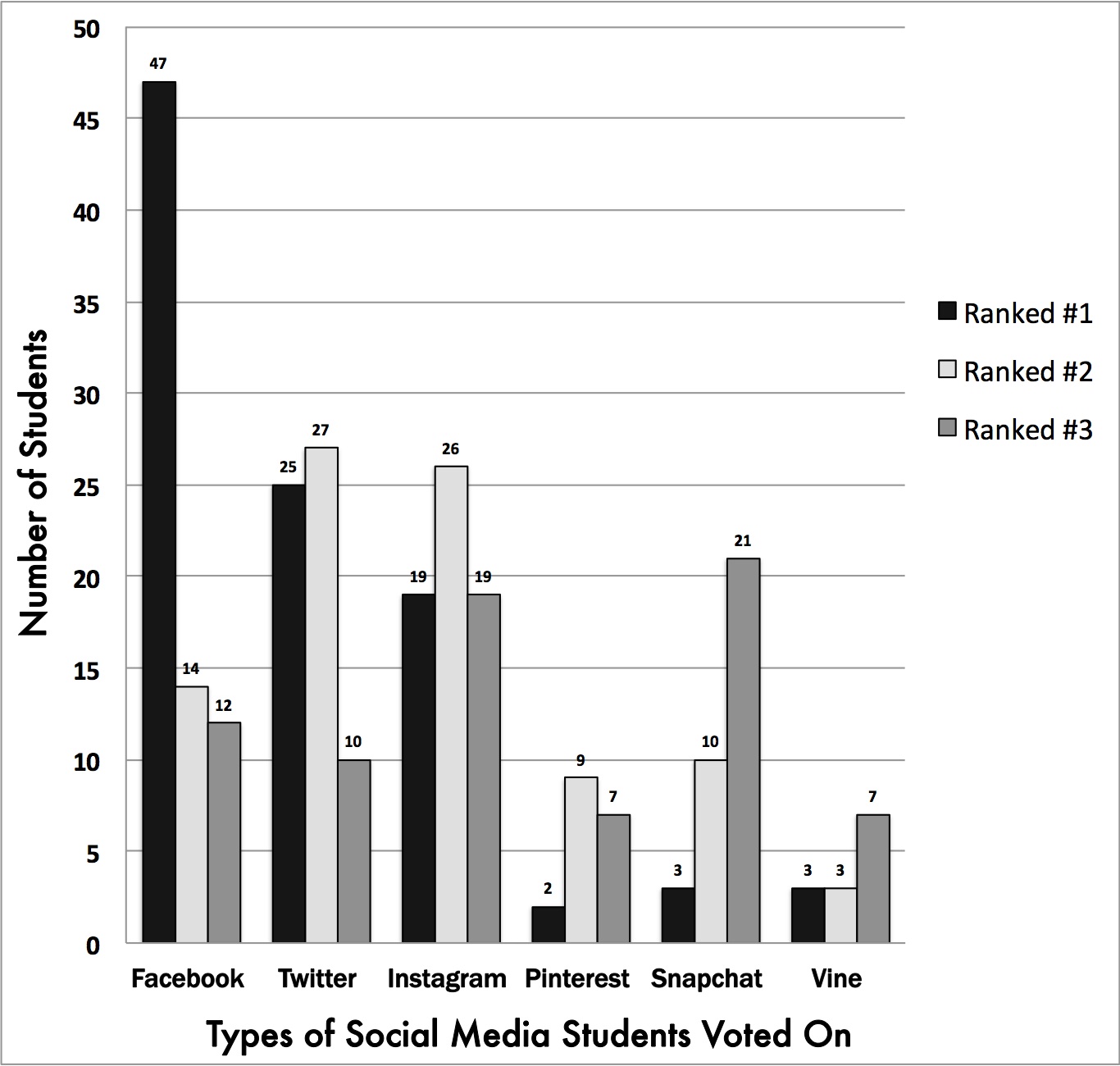
In a recent informal poll taken of 100 random Shorter students ranging from the ages of 17-25, students were asked to state their gender, age and which forms of social media they spend the majority of their time on. The students were asked to pick the top three social media they used the most, with number one being the highest.
From the data collected, 47 students still chose Facebook as their number one most-used form of social media, with 73 students rating Facebook in their top three. The poll also displays that the ever-growing Twitter and Instagram have many users, showing that their popularity is indeed continuing to increase. Snapchat also seems to have many hits, with a total of 34 students rating it in their top three. Pinterest and Vine, though are popular among many, comparatively do not take precedence over the other forms of social media among the students polled.
Is Facebook dead? It seems not, but after many years of its almost absolute dominance in the social media field, perhaps there will be some competition to the monopoly after all.
Student Government Association President and senior history and political science major Mack Parnell says that despite his lacking of a Smartphone, he still stays connected throughout the day.
“I do not have a Smartphone, so I would guess [I check social media] less than the average person,” said Parnell. “I use my iPad to check Facebook five times a day.”
Due to technology, most students get notifications and updates from each social media outlet sent directly to their devices, so students don’t generally stay on the actual Web sites. Instead, they check them at random times throughout the day.
Parnell states Facebook and other social media are also good for keeping up with people.
“It is easier to keep up with people who you might not be in contact with every day. I would not remember anyone’s birthday without it (Facebook),” said Parnell.
Usbeidi Zamora, freshman pre-nursing major, says that she is thankful for Facebook because she stays connected with her friends and family back at home in Newnan, Ga.
“I think social media has affected my life in the positive way that it allows me to share important events in my life,” said Zamora. “Some other advantages of social media are that it allows you to connect with distant family and friends.”
Though social media has great advantages, there are plenty of disadvantages to it, too. Social media can earn negative connotations when people misuse it.
Senior communication major Jessi Clark says that social media is fun, but only when used as it was designed to be used.
“The disadvantages of social media are that it can be used in bad ways such as bullying, false accounts and distraction from more important things,” said Clark.
Parnell pointed out that social media can take away from real-life relationships with others.
“Social media can become consuming if it is allowed,” said Parnell. “People may be so focused on their Facebook friends, they forget the real ones.”
Social media plays a role in students’ lives, but it does not have to define their lives. Most students know their limitations. For example, students are well aware that once information or pictures are on the Internet, it will never disappear.
Social media will not be disappearing any time soon. New apps and outlets may be introduced, and though its usage seems to be slightly fading in the shadows of Twitter and Instagram, Facebook seems to be permanent among this generation.
Nonetheless, it’s safe to say—everything is good in moderation.
